![[personal profile]](https://www.dreamwidth.org/img/silk/identity/user.png)
First Amendment
Feb. 27th, 2024 11:05 am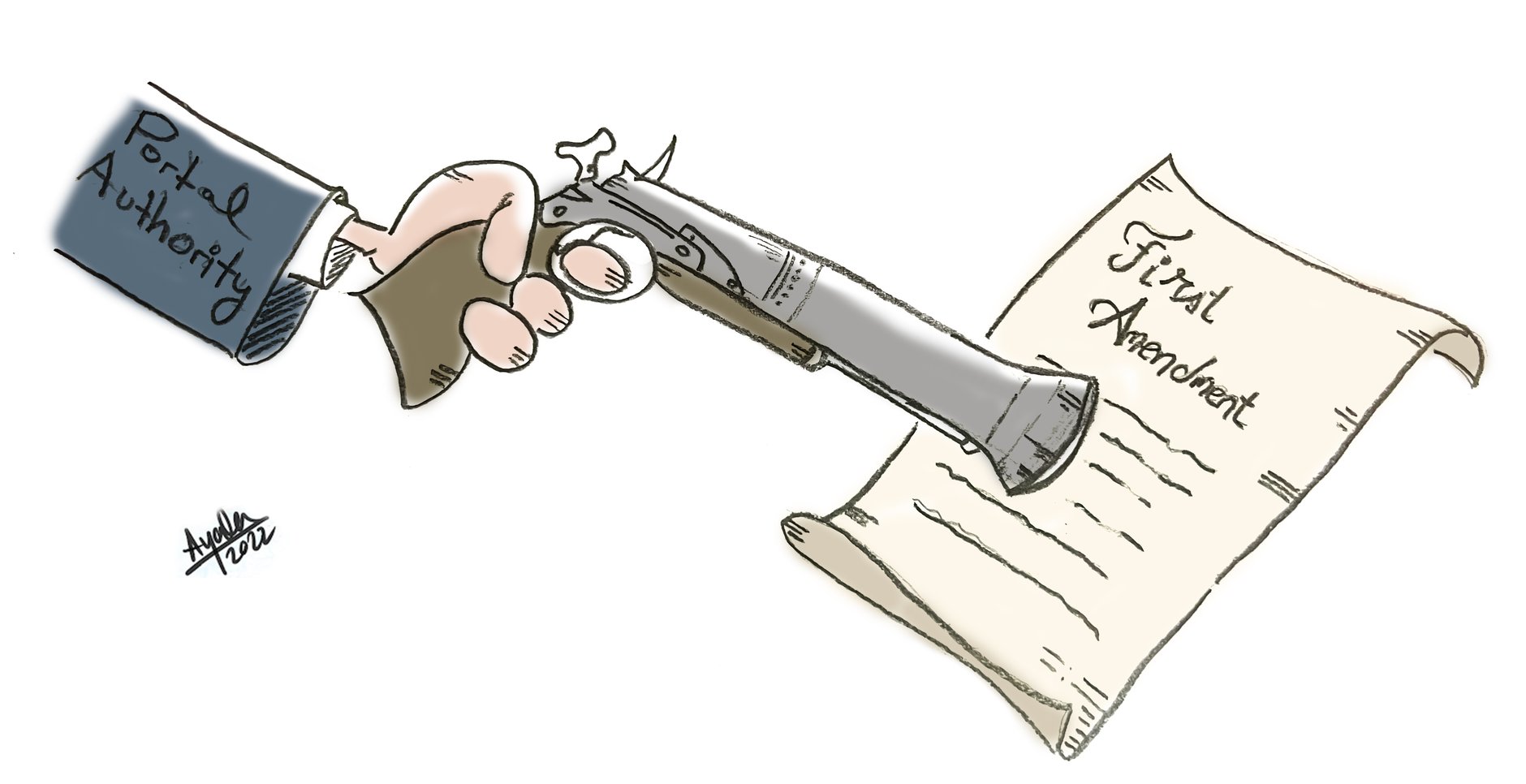 The Supreme Court on Monday grappled with knotty free speech questions as it weighed laws in Florida and Texas that seek to impose restrictions on the ability of social media companies to moderate content.
The Texas and Florida laws prohibit online platforms from removing or demoting user content that expresses certain viewpoints — legislation that came in response to accusations from former President Donald Trump and other conservatives that the platforms were hindering conservative perspectives.
After almost four hours of oral arguments, a majority of the justices appeared skeptical that states can prohibit platforms from barring or limiting the reach of some problematic users without violating the free speech rights of the companies.
But justices from across the ideological spectrum raised fears about the power and influence of big social media platforms like YouTube and Facebook and questioned whether the laws should be blocked entirely.
Trade groups NetChoice and the Computer and Communications Industry Association, known as CCIA, say that both laws infringe upon the free speech rights of companies under the Constitution’s First Amendment by restricting their ability to choose what content they wish to publish on their platforms.
First Amendment free speech protections apply to government actions, not those by private entities, including companies.
Justice Samuel Alito pressed the lawyer representing the Biden administration on why, when a social media company takes down a post, that shouldn’t be described as “censorship” rather than “content moderation.” Alito said he worried about “the Orwellian temptation to recategorize offensive conduct in seemingly bland terms.”
"Why isn't that, you know, a classic First Amendment violation for the state to come in and say, 'We're not going to allow you to enforce those sorts of restrictions'?" asked liberal Justice Elena Kagan, in reference to the Florida law's content moderation provisions. At one point, Justice Elena Kagan noted that the tone and range of content shifted on X after Elon Musk bought the company in October 2022. “A lot of Twitter users thought that was great. And a lot of Twitter users thought that was horrible,” Kagan said. Her point was that the change in tone was a reflection of a change in the company’s own speech, and that such speech is protected from government intrusion by the First Amendment.
Justice Brett Kavanaugh, a fellow conservative whose questions seemed to indicate support for the tech companies, responded by noting that the First Amendment’s prohibition on barring speech only applies to government action.
“When I think of ‘Orwellian,’ I think of the state – not the private sector, not private individuals,” Kavanaugh said. “Maybe people have different conceptions of ‘Orwellian.’”
As Chief Justice John Roberts put it, because the companies are not bound by the First Amendment, "they can discriminate against particular groups that they don't like."
One of the central features of the arguments – particularly in the Florida case – was a debate over which internet sites are covered by the laws. Given the nature of the litigation and the speed with which it arrived at the Supreme Court – that’s not entirely clear.
The justices struggled with how the state laws might be applied to a long list of sites, including popular social media apps Facebook, Instagram, TikTok and YouTube, but also smaller ones like LinkedIn and even sites that are not considered social media, such as Etsy, Uber, Venmo and Google search and Amazon’s cloud computing business.
Even if a majority of the justices agree that social media companies are engaging in First Amendment protected activity when they remove certain users or take down posts, there were many questions about whether the law also applies to sites like Uber or Venmo that perform no similar moderation.
Kagan, a member of the court’s liberal wing, asked why a state couldn’t bar Uber from declining to pick up riders based on political views, for instance.
“When you’re running Venmo you’re not engaged in speech activities and so when a state says to you, “You know what, you have to serve everybody irrespective of whether you like their political opinions or not,’ then it seems you have a much less good argument,” Kagan told the attorney representing the tech industry. “This statute also says that, doesn’t it?”
One question kept coming up during the arguments, just as it has in lower courts: What these state laws could mean for Americans’ overall ability to sue social media companies over content moderation.
The state laws explicitly allow users to sue tech platforms for alleged censorship. But Section 230 of the Communications Decency Act, a 1996 federal law, shields tech platforms from exactly these types of lawsuits — raising questions about how the laws by Texas and Florida might interact with or be preempted by what has become a bipartisan punching bag.
Members of both political parties have railed on Section 230, but for different reasons. Conservatives argue the law lets platforms get away with censorship, while liberals say it gives social media companies a free pass to allow hate speech and other obscene content on their platforms.
Effectively changing the breadth of Section 230 may, in other words, reshape the circumstances under which social media platforms could be sued more broadly.
In May 2022, after the New Orleans-based 5th U.S. Circuit Court of Appeals declined to put the Texas law on hold, the Supreme Court stepped in, preventing it from going into effect. Then, four of the nine justices said the court should not have intervened at that stage.
The Florida measure was blocked by the Atlanta-based 11th U.S. Circuit Court of Appeals, prompting the state to appeal to the Supreme Court.
The challenges to the Texas and Florida laws are among several legal questions related to social media that the Supreme Court is currently grappling with.
A legal question not present in the case but lurking in the background is legal immunity that internet companies have long enjoyed for content posted by their users. Last year, the court sidestepped a ruling on that issue.
Alito suggested the social media companies were guilty of hypocrisy in adopting a free speech argument now when the liability shield was premised on them giving free rein to users to post whatever they want.
He paraphrased the companies' arguments as: "It's your message when you want to escape state regulation. But it's not your message when you want to escape liability."

