![[personal profile]](https://www.dreamwidth.org/img/silk/identity/user.png)


Wrong West's Approach to Weapons
Jun. 12th, 2025 11:39 am Ukraine's defense industry is urging the West to abandon its longtime fixation on high-end, expensive weaponry in favor of cheaper, mass-produced arms, the kind needed to survive and win a grinding war of attrition against an adversary like Russia.
Serhiy Goncharov, the CEO of the National Association of Ukrainian Defense Industries — which represents about 100 Ukrainian companies — told that the West's long-standing focus on fielding limited numbers of cutting-edge systems could be a serious disadvantage in a protracted conflict. Those systems are good to have, but mass is key.
The war in Ukraine shows that instead of a handful of ultraprecise, expensive weapons, countries need a massive supply of good enough firepower, Goncharov said.
He said the expensive weapons such as the US military's M982 Excalibur guided munition (each shell costs $100,000) "don't work" when the other side has electronic warfare systems and the kind of traditional artillery rounds that are 30 times cheaper in tremendous supply.
Goncharov pointed to the M107, a self-propelled gun that was first fielded by the US in the 1960s, as an example of inexpensive firepower that can be effective in large numbers.
"You don't need 10 Archers from the Swedish that are probably one of the best artillery systems in the world," he said, referring to the artillery system made by BAE Systems that was given to Ukraine by Sweden. Instead, you need 200 cheap howitzers, such as the Bohdana one that Ukraine makes.
The significant rate of ammo and equipment attrition in a fight such as this means a constant supply of weaponry is needed to keep fighting, especially when there isn't any guarantee the high-end weapons will be the game changers promised.
Russia's invasion of Ukraine has been marked by extensive use of artillery and tremendous ammunition expenditure. The war in some ways resembles the huge, destructive battles of World War I and World War II, with high numbers of injuries and deaths and substantial equipment losses.
Russia has one of the world's largest militaries, backed by a large population. The country has repeatedly demonstrated a willingness to pursue an attritional style of warfare, committing a lot of troops and weaponry to a fight to slowly wear down its foe.
Russia's invasion has chewed through equipment. The UK Ministry of Defense said in December that Russia had lost more than 3,600 main battle tanks and almost 8,000 armored vehicles since the full-scale invasion began in February 2022.
The Russians have the mass to absorb those losses. Ukraine has struggled with weapon and ammo shortages, as well as deficiencies in manpower. Ukraine turned to small, cheap drones as an asymmetric warfare alternative; Russia has employed uncrewed systems in battle as well.
China, another concern in the West, has built a similar kind of force, one with the mass to take losses.
The West, on the other hand, has spent the past two decades and change fighting lower-level adversaries where its forces can win the day with superior capabilities.
Goncharov's warning is one that has been echoed by other Western defense officials and companies.
Countries have been keen to learn lessons about fighting Russia from the conflict in Ukraine, particularly in Europe, where many countries warn Russia could pursue further aggression in the future, and defense spending is growing rapidly.
Gabrielius Landsbergis, the former defense minister of Lithuania, a NATO ally bordering Russia, previously described the war as one of "high quantities."
He said that while the West had largely focused on new and expensive weaponry that takes a long time to manufacture, Russia had been "building something that's cheap, that's expendable, that's fast."
He said the West had "been preparing for a different kind of war" than what it would face in one against Russia, focusing on impressive equipment that is "very expensive.
Troels Lund Poulsen, the Danish defense minister, previously told BI that "one of the lessons" from Ukraine was that the West needed far greater quantities of inexpensive weaponry to meet the threats posed by Russia and China.
The head of NATO, Mark Rutte, urged countries to take similar learnings earlier this year, saying the alliance was too slow at developing weapons. He said the alliance was working toward perfect, "but it doesn't have to be perfect."
He said Ukraine would go ahead with equipment that was a "6 to 7" out of 10, while NATO militaries insisted on reaching "9 or 10."
He said it wasn't about getting rid of the expensive weaponry completely but about finding a balance: It's about "getting speed and enough quality done in the right conjunction."
Michael O'Hanlon, a senior fellow and the director of research in the foreign-policy program at the Brookings Institution, said the West's approach needed to change. The American military, for instance, is far more used to wars where "the whole point is you're not going to be slogging it out for months and years on end," he said.
But he also said that didn't mean the West needed to completely abandon the development of advanced systems. "Those things have not become unimportant just because we realized that other things are also important," he said.
The UK's armed forces minister also warned last month that the war showed the West needs to change how it procures weaponry. Luke Pollard said Ukraine's fight showed NATO "the way we have run our militaries, the way we have run our defense, is outdated."
He said NATO militaries "build and procure really expensive high-end bits of kit," adding: "It will take you five, 10 years: five years to run a procurement challenge, another 10 years to build it."
Kuldar Väärsi, the CEO of Milrem Robotics, an autonomous uncrewed ground vehicle company in the NATO ally Estonia, told BI in May that "we need to learn from Ukraine, and we need to get more pragmatic about what kind of equipment we buy."
He said Europe needed to learn that "having a hundred more simple pieces of equipment is better than having 10 very sophisticated pieces of equipment."
He said countries needed to start buying less sophisticated pieces of weaponry en masse so industry could adjust. "Industry has to manufacture what the customer is buying. And if the customer is still buying only a few very sophisticated items, then the industry just aligns with that," he said. And the reality is that may not work.
India vs Pakistan
May. 7th, 2025 11:47 am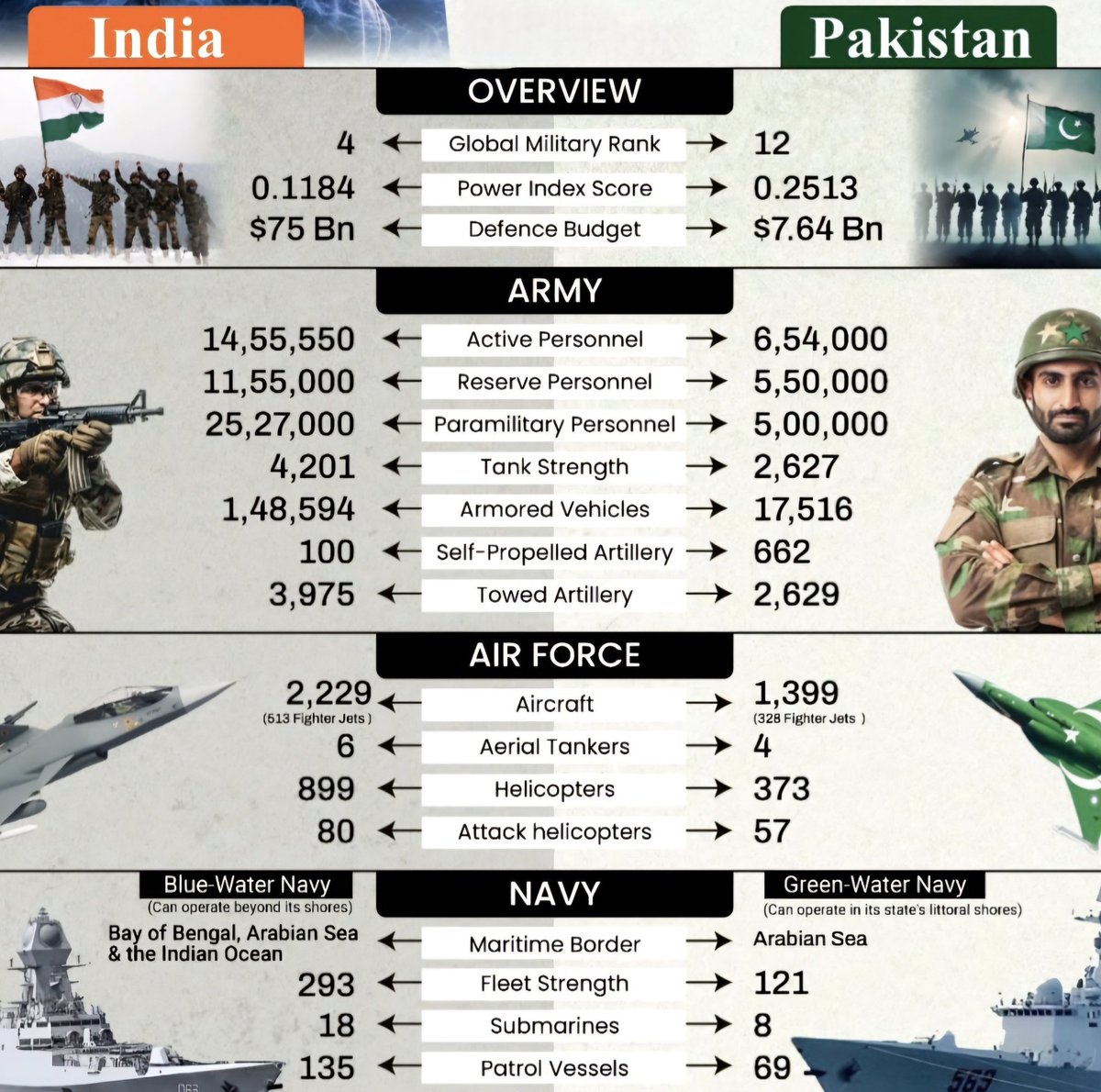 India has launched military strikes against Pakistan, putting the two nuclear-armed neighbours on the brink of an all-out war.
The flare-up means that two of the region’s largest militaries are again in face-to-face conflict.
The stand-off pits India, a global defence giant, against a country that may be much smaller, but is nevertheless heavily militarised and has dedicated a significant share of its resources to preparing for war.
As the world’s most populous nation, India has one of the largest militaries, numbering around 1.4 million active service personnel, which include 1.2 million in the army, 60,000 in the navy and 127,000 in the air force. India also has 1.6 million-strong paramilitary forces and a reserve of 1.1 million.
The country is a defence expenditure heavyweight. Its defence spend reached £58 billion ($77.4 billion) in 2024, the second-highest outlay in Asia after China.
Meanwhile, Pakistan’s population is a fifth of the size and the country has been mired in an economic crisis for years.
Last year, Pakistan’s defence budget was estimated to have been a 10th of that of its eastern neighbour.
Pakistan has become heavily militarised to fend off Indian control, which has come at great cost to its democracy.
The military exerts significant control over the civilian government, with Gen Syed Asim Munir, the head of the army, widely seen as the most powerful man in the country.
While India’s military is increasingly deployed to face China, Pakistan has built up a defence posture and doctrine revolving almost entirely around India.
Pakistan fields a total of around 650,000 active service personnel, including 560,000 in the army, 23,800 in the navy and 70,000 in the air force. It also has 280,000-strong paramilitary forces, according to the International Institute for Strategic Studies.
In limited exchanges, such as those seen in the past 24 hours, Pakistan can punch above its weight, though analysts say that Delhi’s numerical and economic superiority could come to bear very quickly in a full-blown war.
Pakistan has leaned heavily in recent years towards China for its arms, shifting away from more costly Western suppliers.
India has significant quantities of equipment from Russia, but has begun buying more from France and America.
On the battlefield, India is thought to have around 3,100 main battle tanks, including Arjun, T-72 and T-90 models.
Pakistan has around 2,500, which include Al-Khalid, T-80, T-54/55, Type-59/Al Zarrar, Type-69 and Type 85 models.
Each country also has a significant air force. India has a mixture including Dassault Rafale fighters, Sukhoi Su-30s and MiG-29s, MiG-27s and MiG-21s.
Pakistan has Chinese J-10s and JF-17s, as well as American F-16s, Mirage 3s and Mirage 5s.
The two countries may be closer to parity in their nuclear weapons.
India conducted its first nuclear test in 1974 and Pakistan became a nuclear power in 1998.
India has never declared the size of its nuclear armament, but one assessment places the country’s stockpile at 160 nuclear warheads, according to the Centre for Arms Control and Nuclear Proliferation. These can be deployed in land-based ballistic missiles, submarine-launched missiles and aircraft with nuclear bombs and missiles.
Pakistan is estimated to have around 170 warheads and nuclear-capable ballistic missiles of varying ranges. The country can also launch the weapons from planes. In 2017, Pakistan test-fired a submarine-launched missile, though this is not yet thought to be ready for use.
Even a small nuclear exchange between India and Pakistan could kill 20 million people in a week, according to the Centre for Arms Control and Nuclear Proliferation.
.
.
 Europe is scrambling to help Ukraine find a viable replacement for Elon Musk’s Starlink and our of Europe’s largest satellite companies are in talks with European leaders about how to shore up internet connectivity in Ukraine: France’s Eutelsat, Luxembourg’s SES, Spain’s Hisdesat, and Viasat, owner of the UK firm Inmarsat.
Ukraine has been heavily reliant on satellite internet service since the start of the war. Not only can internet infrastructure be easily damaged by the fighting, but the Russian military frequently uses “jamming” techniques that block connections. Ukraine’s digital minister, Mykhailo Fedorov, told that about 40,000 Starlink terminals are in use across the country.
The news comes after reports surfaced last month that the US had threatened to cut off access to Starlink if Ukraine failed to agree to a deal giving it access to mineral resources. SpaceX CEO Elon Musk denies it, calling Reuters, which first reported the rumors, "legacy news liars" in a post on X(More details: https://x.com/elonmusk/status/1893375607079059629).
Despite the importance of Starlink to Ukraine's infrastructure, Europe could still potentially provide a partial solution if Starlink access were cut off. “A patchwork” of European services owned by European companies could provide backup, such as for critical operations like government infrastructure or healthcare.
However, this approach would have significant limitations. Lluc Palerm Serra, research director at consultancy Analysys Mason, told that none of these possible alternatives “can offer the level of supply that Starlink has.”
At present, Eutelsat is one of the small number of satellite networks that can provide functioning global internet coverage that can compete with Starlink. Its share price has skyrocketed since the high-profile public argument between Donald Trump and Ukrainian President Volodymyr Zelenskyy last week.
Europe is making headway toward creating its own satellite internet infrastructure to reduce its reliance on Starlink, but it may be a long time before these plans come to fruition. The European Union plans to launch IRIS², its low-orbit satellite network, in 2027, but it is not expected to be operational until the early 2030s.
But it's not just European leaders who are concerned about the possibility of Ukraine losing access to vital connectivity. Grassroots efforts have emerged on social networks like Reddit and X in recent weeks, with people encouraging users to boycott Starlink if it cuts off access to the war-torn country.
.
Europe is scrambling to help Ukraine find a viable replacement for Elon Musk’s Starlink and our of Europe’s largest satellite companies are in talks with European leaders about how to shore up internet connectivity in Ukraine: France’s Eutelsat, Luxembourg’s SES, Spain’s Hisdesat, and Viasat, owner of the UK firm Inmarsat.Ukraine has been heavily reliant on satellite internet service since the start of the war. Not only can internet infrastructure be easily damaged by the fighting, but the Russian military frequently uses “jamming” techniques that block connections. Ukraine’s digital minister, Mykhailo Fedorov, told that about 40,000 Starlink terminals are in use across the country.
The news comes after reports surfaced last month that the US had threatened to cut off access to Starlink if Ukraine failed to agree to a deal giving it access to mineral resources. SpaceX CEO Elon Musk denies it, calling Reuters, which first reported the rumors, "legacy news liars" in a post on X(More details: https://x.com/elonmusk/status/1893375607079059629).
Despite the importance of Starlink to Ukraine's infrastructure, Europe could still potentially provide a partial solution if Starlink access were cut off. “A patchwork” of European services owned by European companies could provide backup, such as for critical operations like government infrastructure or healthcare.
However, this approach would have significant limitations. Lluc Palerm Serra, research director at consultancy Analysys Mason, told that none of these possible alternatives “can offer the level of supply that Starlink has.”
At present, Eutelsat is one of the small number of satellite networks that can provide functioning global internet coverage that can compete with Starlink. Its share price has skyrocketed since the high-profile public argument between Donald Trump and Ukrainian President Volodymyr Zelenskyy last week.
Europe is making headway toward creating its own satellite internet infrastructure to reduce its reliance on Starlink, but it may be a long time before these plans come to fruition. The European Union plans to launch IRIS², its low-orbit satellite network, in 2027, but it is not expected to be operational until the early 2030s.
But it's not just European leaders who are concerned about the possibility of Ukraine losing access to vital connectivity. Grassroots efforts have emerged on social networks like Reddit and X in recent weeks, with people encouraging users to boycott Starlink if it cuts off access to the war-torn country.
 The bacterium Serratia marcescens lives in soil and water, and is best known for its ability to produce bright red pigment. This flashy trait makes this particular microbe useful in experiments—because it is so bright, it's easy to see where it is. And in 1950, the U.S. military harnessed that power in a large-scale biowarefare test.
Beginning on September 26, 1950, the crew of a U.S. Navy minesweeper ship spent six days spraying Serratia marcescens into the air about two miles off the northern California coast. The project was called “Operation Sea Spray,” and its aim was to determine the susceptibility of a big city like San Francisco to a bioweapon attack by terrorists.
In the following days, the military took samples at 43 sites to track the bacteria's spread, and found that it had quickly infested not only the city but surrounding suburbs as well. During the test, residents of these areas would have inhaled millions of bacterial spores. Clearly, their test showed, San Francisco and cities with similar size and topography could face germ warfare threats. “In this regard, the experiment was a success.
But there was a catch. At the time, the US military thought that Serratia couldn’t harm humans. The bug was mostly known for the red spots it produced on infested foods and had not been widely linked to clinical conditions. That changed when one week after the test, 11 local residents checked into a Stanford University Hospital complaining of urinary tract infections.
Upon testing their pee, doctors noticed that the pathogen had a red hue. “Infection with Serratia was so rare that the outbreak was extensively investigated by the University to identify the origins of this scarlet letter bug,” writes Kreston. After scientists identified the microbe, the cases collectively became the first recorded outbreak of Serratia marcescens. One patient, a man named Edward Nevin who was recovering from prostate surgery, died, and some have suggested that the release forever changed the area's microbial ecology(More details: https://www.sfgate.com/health/article/Serratia-has-dark-history-in-region-Army-test-2677623.php).
The military had performed similar tests in other cities across the country over the next two decades, until Richard Nixon halted all germ warfare research in 1969. The San Francisco experiment didn’t become public knowledge until 1976.
Russia's Secret Weapon
Oct. 12th, 2024 02:15 pm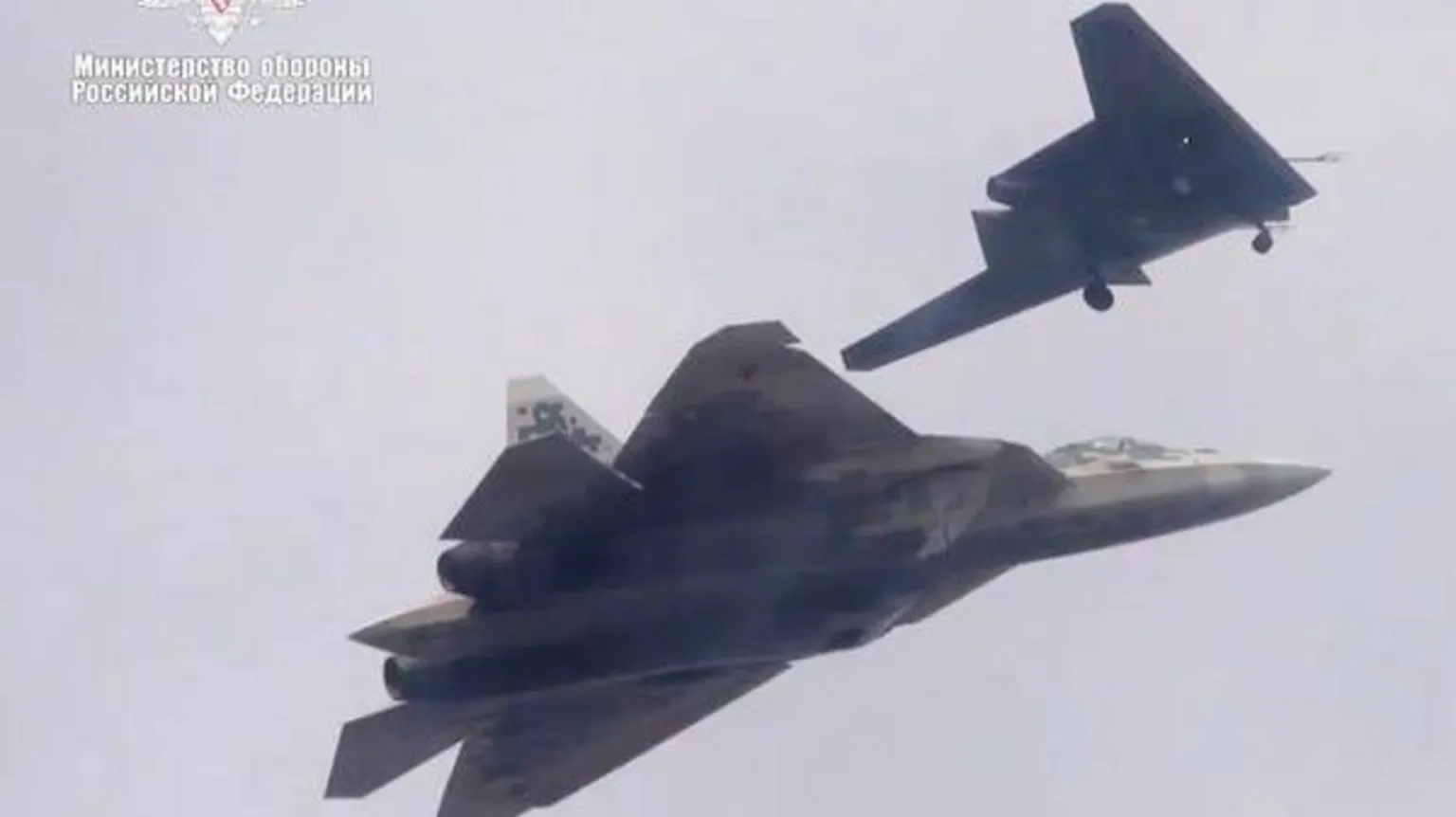 When two white vapour trails cross the sky near the front line in eastern Ukraine, it tends to mean one thing. Russian jets are about to attack.
But what happened near the city of Kostyantynivka was unprecedented. The lower trail split in two and a new object quickly accelerated towards the other vapour trail until they crossed and a bright orange flash lit up the sky.
Was it, as many believed, a Russian war plane shooting down another in so-called friendly fire 20km (12 miles) from the front line, or a Ukrainian jet shooting down a Russian plane?
Intrigued, Ukrainians soon found out from the fallen debris that they had just witnessed the destruction of Russian’s newest weapon - the S-70 stealth combat drone.
This is no ordinary drone. Named Okhotnik (Hunter), this heavy, unmanned vehicle is as big as a fighter jet but without a cockpit. It is very hard to detect and its developers claim it has “almost no analogy” in the world.
That all may be true, but it clearly went astray, and it appears the second trail seen on the video came from a Russian Su-57 jet, apparently chasing it down.
The Russian plane may have been trying to re-establish the contact with the errant drone, but as they were both flying into a Ukrainian air defence zone, it is assumed a decision was made to destroy the Okhotnik to prevent it ending up in enemy hands.
Neither Moscow nor Kyiv have commented officially on what happened in the skies near Kostyantynivka. But analysts believe the Russians most likely lost control over their drone, possibly due to jamming by Ukraine’s electronic warfare systems.
This war has seen many drones but nothing like Russia’s S-70. It weighs more than 20 tonnes and reputedly has a range of 6,000km (3,700 miles).
Shaped like an arrow, it looks very similar to American X-47B, another stealth combat drone created a decade ago.
The Okhotnik is supposed to be able to carry bombs and rockets to strike both ground and aerial targets as well as conduct reconnaissance.
And, significantly, it is designed to work in conjunction with Russia’s fifth-generation Su-57 fighter jets.
It has been under development since 2012 and the first flight took place in 2019.
But until last weekend there was no evidence that it had been used in Russia’s two-and-a-half-year war in Ukraine.
Earlier this year it was reportedly spotted at the Akhtubinsk airfield in southern Russia, one of the launch sites to attack Ukraine.
So it is possible the abortive flight over Kostyantynivka was one of Moscow’s first attempts to test its new weapon in combat conditions.
Wreckage of one of Russia’s notorious long-range D-30 glide bombs was reportedly found amidst the aircraft’s crash site.
These deadly weapons use satellite navigation to become even more dangerous.
So what was the Okhotnik doing flying with an Su-57 jet? According to Kyiv-based aviation expert Anatoliy Khrapchynskyi, the warplane may have transmitted a signal from a ground base to the drone to increase the extent of their operation.
The stealth drone’s failure is no doubt a big blow for Russia’s military. It was due to go into production this year but clearly the unmanned aircraft is not ready.
Four protype S-70s are thought to have been built and it is possible the one blown out of the sky over Ukraine was the most advanced of the four.
Even though it was destroyed, Ukrainian forces may still be able to glean valuable information about the Okhotnik.
“We may learn whether it has its own radars to find targets or whether the ammunition is pre-programmed with co-ordinates where to strike,” explains Anatoliy Khrapchysnkyi.
Just by studying images from the crash site, he believes it is clear the drone’s stealth capabilities are rather limited.
As the engine nozzle’s shape is round, he says it can be picked up by radar. The same goes for the many rivets on the aircraft which are most likely made of aluminium.
No doubt the wreckage will be pored over by Ukrainian engineers and their findings passed on to Kyiv’s Western partners.
And yet, this incident shows the Russians are not standing still, reliant on their massive human resources and conventional weapons.
They are working on new and smarter ways to fight the war. And what failed today may succeed next time.
Drones War
Jun. 4th, 2024 04:15 pmThe military was working to protect its newly constructed aid pier in Gaza, not from a direct attack or an assault by conventional forces, but from drones. The Army is using a pair of experimental new vehicles designed to track incoming drones and then either disrupt their signal or shoot them down(More details: https://www.msn.com/en-us/news/world/the-us-army-s-drone-problem-and-how-it-s-solving-it/ar-BB1n6BLm).
All of that is happening as the various military branches consider whether or not they should each implement their own individual anti-drone corps, or work together to form a unified front against the threat that drones bring to the modern battlefield. One thing that is clear is that drones are changing warfare, with over 100,000 combat drones being used each month by both sides fighting in Ukraine.
Protecting the pier in Gaza is one way to field test new anti-drone weapons systems, although even as the pier has apparently been scouted by drones, there have been no actual attacks made against it, according to the Telegraph article. So, that may not be a great preview of how anti-drone systems might perform on a battlefield, where drone swarms are becoming an increasingly effective tactic. But there is one place where American troops and their NATO allies are already facing off against swarms of tactical drones and other unmanned vehicles, and plotting ways to combat and ultimately defeat them.
Those pitched battles are taking place in highly realistic but virtualized environments. And while there are casualties, nobody ever really gets hurt.
One of the most detailed military simulations in use today is the Virtual Battlespace 4 — or VBS4 — system, which is an entire virtualized environment designed to be able to train soldiers inside virtual reality for combat anywhere in the world. The world of VBS4 is fully simulated, meaning that soldiers are able to look at and use realistic weapons systems just like they would in real life, through the use of virtual reality headsets and other sensors. The VBS4 also recently upgraded its artificial intelligence to provide more realistic adversaries, where each individual enemy combatant is able to think for themselves, as opposed to just having an overall grand strategy. There is even a recently-launched Ukrainian Battle Simulation which lets allied countries fight realistic battles inside Ukraine against Russian troops — just in case such training would ever be needed(More details: https://bisimulations.com/products/vbs4).
The VBS4 platform is created by Bohemia Interactive Simulations(BIS), and is used by over 60 nations for intense, virtual training, including the United States. Those advancements used to come every year or so, but with the evolving battlefield in Ukraine they are now being deployed at a much more rapid pace, especially if updates pertain to drones or AI.
Drones are a step-change in warfare, providing unprecedented tactical situational awareness and a new offensive capability like loitering munitions or kamikaze drones. To reflect the changing nature of warfare, we’ve been continuously adding new drone capabilities in VBS based on real-world developments observed in publicly available information.
This allows NATO forces to develop counter-drone tactics and prototype new defense technologies within the simulation. Additionally, we've incorporated advanced AI to simulate drone behavior, reducing the need for human operators in training scenarios focused on defeating drone attacks.
The Ukraine conflict highlighted limitations in traditional simulations and wargames regarding logistics and the impact of morale on operations. Simulating force-on-force engagements like tank platoons fighting is relatively easier than accurately replicating larger-scale Brigade-level operations.
Early in the Ukrainian conflict, Russian supply chain failures and stalled armored advances due to single vehicle losses demonstrate these limitations. Simulations don't necessarily require more weapons platforms, but rather improved capabilities for simulating real soldiers operating within a conventional war.
At BISim, main approach utilizes AI to simulate every soldier individually, replacing traditional roll the dice aggregation methods and currently scaling this entity-level simulation using cloud technology.
The VBS4 is primarily used for tactical training and mission rehearsal. Scenarios are designed with specific learning objectives in mind, like a company clearing a city block or a battalion practicing a convoy mission. And VBS scenarios involve human participants ranging from a few people to hundreds, so the AI needs to support those training goals. This means it must be controllable by the administrator and repeatable to facilitate training effectiveness.
While there might be future demand for more intelligent AI in VBS, we haven't witnessed that need yet. It's important to remember that military simulations encompass various types. For instance, intelligent AI could be highly valuable for high-level wargaming, potentially identifying gaps in a commander's plan or even advising forces on the most suitable strategy based on real-time situations.
BIS current AI utilizes behavior trees for controllability and repeatability, as previously mentioned. While advancements in generative AI are exciting, their application in tactical military AI remains unclear. GenAI excels at processing vast amounts of data and offering intelligent summaries, but this differs significantly from analyzing a tactical situation and developing a solution or generating autonomous AI behavior.
BIS see machine learning AI having a more immediate impact on autonomous weapon platforms, which pose a significant future threat. Drones capable of making autonomous kill decisions without human input will be challenging to counter, and NATO needs to prioritize addressing this. Simulations like VBS can provide a testing ground for the AI driving those drones to develop tactics to counter them.
In addition to VBS's military simulation capabilities, BIS also specialize in recreating real-world environments for training and mission rehearsal and planning. A recent example is BIS high-fidelity Ukrainian terrain, developed in collaboration with LuxCarta.
This Ukrainian terrain can serve as a foundation for creating new training scenarios or even replicating real-world events, such as rehearsing using past Russian assaults. This benefits both Ukrainian and NATO forces. Our partnership with LuxCarta allows us to rapidly generate new simulation terrains, reflecting real-world changes like trench digging or infrastructure destruction.
This is a game-changer for modern militaries. They can now train virtually on terrain that precisely replicates their upcoming deployment or operational zone.
BIS enthusiastic about delivering entity-level simulation capabilities at a massive scale very soon. Traditionally, simulating every entity within large formations has been a limitation of military simulations. This is why constructive simulations rely on aggregation and so-called rolling the dice for outcomes. But our high-fidelity entity-level AI is now being combined with cloud technology to simulate massive numbers of individual units. This will be a game-changer, hopefully providing more realistic outcomes in AI-vs-AI engagements at scale.
Anduril Industries says it wants to become the Lockheed Martin of the 21st century. One way the defense-tech startup, cofounded by billionaire Palmer Luckey, is trying to get there is by developing gear on its own dime rather than waiting for Pentagon contract competitions. It’s betting that it knows what the U.S. military is going to want.
On last Friday, the Southern California-based Anduril pulled the wraps off its latest ambitious bet: an autonomous jet-powered drone designed to serve as an interceptor of aerial threats ranging from large drones to manned aircraft. Anduril says it already has a buyer that it will only describe as a “U.S. customer” and it’s set to launch production at a rate of hundreds of them a year.
The customer appears to be U.S. Special Operations Command, which signed a $12.5 million contract with Anduril last year for Roadrunner counter-drone hardware.
The company says the drone, called Roadrunner, is powered by twin turbojet engines that enable it to reach “high subsonic speed” — presumably approaching 700 mph. It launches vertically from a climate-controlled box called a Nest that Anduril says will keep the drone ready to go for months at a time in harsh field conditions.
The concept is that squadrons of Roadrunners can be dispatched to assess a threat picked up on radar or reported by observers. If the blip turns out to be a hostile aircraft, a Roadrunner equipped with a warhead will intercept and blow it up, along with itself. If it’s a false alarm, the drone can return to base and land on its tail vertically.
The drone costs in the “low hundreds of thousands of dollars,” Luckey, the loquacious tech wunderkind, told reporters on a video-conference call, and its value is enhanced by its reusability.
“This is a totally new category of weapon that’s never really existed before,” he said. “It’s somewhere between a reusable missile and a full-scale autonomous aircraft.”
Roadrunner, which Luckey first described in broad strokes to Forbes last year, was designed to defeat an emerging class of aerial threats that lie between small quadcopters and ballistic missiles. That kind of threat has been seen in Ukraine, where Russia is trying to overwhelm Ukrainian air defenses with barrages of missiles and one-way kamikaze attack drones like Iran’s Shahed.
“The requirements that we built into Roadrunner were focused on addressing the threat, where it was going and then where we believe it’s going to continue to metastasize beyond where it is today,” said Christian Brose, Anduril’s chief strategy officer.
Anduril declined to share specs on Roadrunner’s capabilities, but claims that compared with similar drones on the market it has three times the warhead payload capacity, 10 times the one-way effective range, and is three times more maneuverable.
Its name is a playful jab at one competitor: RTX’s Coyote Block 2, also a jet-powered, kamikaze counter-drone system, which is being used by the U.S. Army. (As Looney Tunes fans know, Roadrunner always beats Coyote.)
Roadrunner’s engines, which Anduril developed in-house, are “the most power-dense turbojet engines that have ever been built,” Luckey said.
The company says a single operator can launch and supervise multiple Roadrunner squadrons. The aircraft are capable of autonomously determining flight paths, including intercept courses against a maneuvering target after being given the command to destroy.
A big part of Roadrunner’s value, Luckey and Brose said, lies in the ability to use it to scope out an unclear threat rather than scrambling a manned fighter, which is expensive, or having to make a quick decision to launch a missile.
“The benefit of the Roadrunner is that you can launch without regret,” said Brose.
A hasty error by an air defense battery can lead to tragedy, like the 2020 downing of a Ukrainian airliner in Iran at a time when Iranian forces were on high alert for potential American retaliation to their missile attacks on U.S. bases in Iraq.
“I think that Roadrunners, most of their missions are not going to be blowing up,” said Luckey. “Most of the time it’s going to be launching, minimizing your risk and getting more information on what exactly things are.”
It’s unclear whether Roadrunner could be used to intercept faster fighter jets, but it could take some stress off air forces in places like Taiwan and Japan, which have been forced to scramble their fighters at a high tempo in recent years to respond to airspace incursions by Chinese aircraft.
Anduril plans to produce non-kamikaze Roadrunners with different types of payloads, such as electronic warfare equipment. Luckey also said the company envisions using them to fight forest fires. If the beginning of a blaze is picked up by satellite or other means, a Roadrunner could jet to the scene and drop a fire suppressant. (Fighting wildfires has become a preoccupation of tech titans following the blazes that have swept across the U.S. West recently.)
The performance claims Anduril is making sound plausible, Zachary Kallenborn, a drone expert who’s an adjunct fellow with the Center for Strategic and International Studies, told Forbes. Rising use of autonomy will eventually render obsolete one the most effective current defenses against drones — jamming the radio control links to their remote pilots — calling for more brute force countermeasures like Roadrunner, he noted.
But the interceptor drone’s value proposition seemed unclear to him based on the limited information Anduril is sharing.
At a few hundred thousand dollars a pop, using Roadrunner to down a drone like a Shahed-136, which is estimated to cost from $20,000 to $50,000, may make more financial sense than firing a $4 million Patriot missile. But Ukraine appears to have had success taking out the medium-size drones with much cheaper bullet fire from heavy machineguns.
RTX’s Coyote counter-UAS drone, which Army budget documents suggest may cost roughly half as much as Roadrunner or less at $118,000 per interceptor, is believed to be effective against what are classified by size as smaller Group 1 and Group 2 unmanned air systems (Shahed is a Group 3).


3D-Printed Gun
Aug. 28th, 2018 08:41 am In late July, the US State Department settled a case that allowed Defense Distributed to release plans online to 3D print a gun it called “The Liberator”—plans the organization had been trying to make publicly available for some time. Defense Distributed is a private firm “principally engaged in the research, design, development, and manufacture of products and services for the benefit of the American rifleman,” according to its website.
Founder of Defense Distributed, Cody Wilson, designed The Liberator, which is a pistol that holds a single shot. He first released the plans in 2013 so people could download them, but was legally forced to take them offline not long after—the recent decision reversed by the court. At the time, he claimed that the plans were downloaded more than 100,000 times in the first days of posting.
The Liberator is primarily made from plastic parts that are 3D printed, save a metal nail that acts as a firing pin and a small piece of steel that allows the gun to be identified using a metal detector. This latter part is essential to the plan, due to the fact that the US Undetectable Firearms Act prohibits the legality of weapons that don't set off a metal detector.
Almost immediately after the decision to allow 3D-printed gun plans to again be available online, they were challenged in court. Eight states filed suit to block the plans and 11 more joined them a few days later. In addition, 20 state attorneys separately sent a letter to the US State Department and the Department of Justice to stop the plans from being shared online.
It’s likely that the political and social debate over whether firearms should be 3D-printed at home will continue, as the situation is currently pending. In the meantime, researchers continue to advance 3D printing and additive manufacturing technology using various materials for personal, commercial, and large-scale manufacturing purposes.


