paserbyp: (Default)
Russia just put Bitcoin at the center of its economic chessboard. Earlier today, President Vladimir Putin signed a law that not only recognizes Bitcoin and other cryptocurrencies as legal property but also brings a lot of new regulations to the industry.

The new law rewrites Russia’s Tax Code, turning crypto into a taxable asset. It exempts mining and sales from value-added tax (VAT), but miners must report their activities to local authorities or risk a fine of 40,000 rubles (about $380).

Trading profits are also on the radar, with a tiered tax system: 13% for earnings under 2.4 million rubles ($22,300) and 15% for anything higher.

Starting next year, all crypto companies will face a standard tax rate of 25%. Most parts of this law are effective immediately, except for a few delayed clauses.

Russia anticipates collecting up to 200 billion rubles (around $2 billion) annually from its booming crypto mining sector. And given the country’s global rank as a mining powerhouse, the numbers don’t seem at all far-fetched.

Russia has consistently ranked among the top players in crypto mining, with its abundance of cheap energy fueling massive operations. Now on November 1, a government-backed database for large-scale miners was launched under a separate law Putin signed in August.

The stakes are bigger than just domestic control. Russia’s Central Bank has also greenlit a pilot program for cross-border crypto transactions. These transactions are seen as a lifeline for Moscow, allowing the country to sidestep sanctions and purchase restricted goods on international markets.

Crypto’s decentralized nature makes it harder for Western regulators to track, giving Russia a potential edge in accessing critical resources — military or otherwise.

Of course, this doesn’t sit well with the United States. Washington has warned banks in countries like China, Turkey, and the UAE against aiding Moscow’s efforts to bypass sanctions. But let’s be honest, Moscow isn’t losing sleep over U.S. threats these days.

While Putin is busy legitimizing Bitcoin, the ruble is hitting rock bottom. This week, it sank to 114 against the U.S. dollar, its weakest since March 2022. Russia’s central bank had to step in, halting foreign currency purchases on the domestic market to stabilize the ruble.

By Thursday, it had clawed back some ground, trading at 110 to the dollar, but the damage was done. Putin, as usual, downplayed the crisis. “There are absolutely no grounds for panic,” he said, attributing the ruble’s slide to seasonal factors and budgetary payments.

Kremlin spokesman Dmitry Peskov chimed in, insisting the decline wouldn’t affect ordinary Russians because they earn salaries in rubles. Sure. But analysts aren’t buying it.

Timothy Ash, an emerging markets strategist, described the ruble as being in “free fall,” calling it a proper currency crisis in the making. A weaker ruble means higher inflation, rising interest rates, and slower economic growth.

Inflation was already at 8.5% in October, with staples like butter and potatoes costing significantly more than last year. But don’t get it twisted, the currency collapse is tied to more than just seasonal changes.

New U.S. sanctions targeting Gazprombank have added pressure, while Russia’s war-driven economy is stretching resources thin. Defense spending has skyrocketed, with funds pouring into domestic weapons production.

Despite this, Putin denies the country is sacrificing consumer welfare for military priorities, famously rejecting the notion of “butter for guns.” Meanwhile, the International Monetary Fund recently revised its GDP forecast for Russia, projecting 3.6% growth in 2024.

That’s not bad considering the circumstances, but the IMF also warned of a slowdown in 2025, with growth expected to drop to 1.3%. Private consumption and investment are slowing, labor markets are tightening, and wage growth is losing steam.

As the ruble crumbles and sanctions bite, looks like Bitcoin is stepping up both as a tool and a symbol of economic resistance.
paserbyp: (Default)
More than two hours into Republican former President Donald Trump’s World Liberty Financial launch event on X Monday night, the team behind the Trump family’s new crypto project finally unveiled a key detail: Who can buy the forthcoming tokens it plans to release, and how shares of the project will be allotted.
For over a month, the former president and his family have been pumping up the endeavor with vague descriptions, promising that it will do many things at once.

Lofty goals set by those involved in the project on Monday night’s X space suggest that World Liberty Financial will be a sort of crypto banking platform, where the general public will be encouraged to borrow, lend and invest in crypto.

There will also be an accompanying token called WLFI, founders said Monday.

The equity structure for these tokens will be that 20% of the project’s tokens are allotted to the founding team, which includes the Trumps, 17% of tokens are set aside for user rewards, and the remaining 63% of the coins will be made available for the public to purchase, said founder Zak Folkman.

There will be no pre-sales or early buy ins, Folkman added.

An earlier leaked draft of an internal project outline had the founders’ share at 70%, sparking concerns that the project would be little more than a get-rich-quick scheme.

The token will be a Reg D token offering, which follows the Securities and Exchange Commission’s Regulation D — a provision that makes it possible for a company to raise capital without first registering their securities with the commission so long as certain conditions are met.

These were themes that Trump covered in a conversation format early on in the more than two hour event, as he spoke about the perceived hostility of the Securities and Exchange Commission towards the digital currency industry.

Several high profile figures in the industry take issue with SEC Chair Gary Gensler, claiming that he is regulating the industry through enforcement actions, rather than via rules.

Over the course of Trump’s 40-minute fireside chat at the top of the more than two hour livestream, he talked about how he “wasn’t overly interested” in crypto initially.

But that changed, he said, when sales of his Trump trademarked nonfungible token collections were paid for with crypto. “I think my children opened my eyes more than anything else.”

“Crypto is one of those things we have to do,” Trump said near the end of his remarks. “Whether we like it or not, we have to do it.”

Monday’s event came at an unprecedented moment for Trump’s presidential campaign.

Witkoff is a longtime friend of Trump’s. He’s also part of the small group of World Liberty Financial founders.

Witkoff was seated to Trump’s right during Monday night’s livestream, and described how he brought the Trump family together with two crypto entrepreneurs to get the project started.

“My son introduced me to two partners, Chase Herro and Zak Folkman, who are exceptionally bright people ...These guys are as smart as any currency traders I’ve ever met. And they began talking to me about decentralized finance, which means frictionless finance, and why it made sense for people. And about the forgotten, who can’t get credit out there,” Witkoff said.

“As I began to understand that, I said, ‘Who would understand this better than the Trump family?’ And we had a meeting initially with Eric, Don Jr., and the president and his counsel. And we said, ‘Let’s go pursue it.’ We’ve been on it for close to nine months,” said Witkoff.

As Witkoff spoke, the parallels between World Liberty Financial and Trump’s other recent venture, Trump Media & Technology Group, were inescapable.

In Trump Media’s case, two former cast members from Trump’s NBC hit reality show “The Apprentice” approached Trump in 2021 with an idea for a new, conservative social media platform.

Three and a half years later, Trump Media’s publicly traded stock has boosted Trump’s net worth by billions of dollars, and Truth Social is his social platform of choice.

Alongside Trump and Witkoff, founders of World Liberty Financial include Donald Trump Jr., Eric Trump and Barron Trump, as well as Witkoff’s son, Zach Witkoff.

A copy of an early internal report, known as a white paper and obtained by CoinDesk, listed Barron as “Chief DeFi Visionary,” Eric and Donald Jr. as “Web3 Ambassadors,” and Trump Sr. as “Chief Crypto Advocate.”(More details: https://www.coindesk.com/business/2024/09/03/inside-the-trump-crypto-project-linked-to-a-2m-defi-hack-and-former-pick-up-artist).

But while the Trumps will receive compensation from the project, the platform itself is “not owned, managed, operated or sold” by members of the Trump family.

Witkoff, a real estate investor, and Eric Trump, executive vice president of the Trump Organization, are the two people calling the shots at World Liberty Financial, according to a person familiar with the project. Both are new to the crypto industry.

Until Monday, much of what the public knew about World Liberty was based on interviews Trump’s sons had given to the press over the past month, as well as a leaked white paper that served as a sort of crypto project manifesto, and conversations with insiders.

Anyone who wanted material details of the platform, including the white paper, was asked to sign a non-disclosure agreement, according to a person familiar with the project.

World Liberty Financial represents the latest step in Donald Trump’s evolving political and personal relationship with the crypto industry.

Some visible figures in crypto have cozied up to Trump during the 2024 election cycle, lending their cash and endorsements to the Republican nominee for president.

At the same time, Trump has adopted increasingly bullish talking points about crypto on the campaign trail. This culminated in his delivery of a keynote address in July at the biggest bitcoin event of the year in Nashville, Tennessee(More details: https://www.cnbc.com/2024/08/26/trump-orange-pilled-by-three-bitcoiners-in-puerto-rico-100-million.html).

Founders offered scant details on Monday about any future timelines for the project, saying only that new information will be shared on official social media channels, and warning fans not to fall for scams.
paserbyp: (Default)
Mark Scott’s wife, sitting in the spectators’ gallery just behind him, wailed uncontrollably after the New York jury passed down its verdict on November, 2019. Bank fraud — guilty. Money laundering — guilty. The 51-year-old Scott, turned out in a smart suit and expensive tan, consoled his wife over the railings. Scott used to boast to friends about earning “50 [million] by 50”, something he had achieved by laundering £300m worth of profits from the “OneCoin” cryptocurrency via layered private equity investment funds and offshore bank accounts. Now he faces up to 50 years in prison.

Money laundering cases are ten a penny, but Scott was involved in what may be the biggest financial scam since Bernie Madoff was convicted of fleecing investors of almost £12bn a decade ago. Scott is due to be sentenced in February, but the mastermind behind OneCoin, a German-Bulgarian businesswoman called Dr Ruja Ignatova, remains at large, and several billion pounds of investors’ money is missing.

Six years ago, Dr Ruja, as she styles herself, was a high-flying consultant working in international finance. Then she heard about bitcoin, the strange new digital money not backed by central banks or governments. As the price of bitcoin started to rise, Ignatova spotted an opportunity. Rather than invest, she went one better and designed her own: OneCoin. It was, she claimed, simpler and safer than its better-known rival. You don’t need to be a computer whizz to buy OneCoin, she said. Just send some money to a bank account and you’ll receive them in a personal online account. Because it’s designed for the mass market, she promised, it will soon be bigger than bitcoin.

Propelled by the cryptocurrency gold rush, OneCoin started to grow. Ignatova addressed enormous crowds in London, Macau, Dubai and Singapore. Potential investors were shown photos of her on the front cover of prestigious business magazines. Videos of her giving a speech at a glitzy event organised by The Economist circulated on Facebook. All over the world people were sending their money and setting up OneCoin accounts. Small villages in Uganda clubbed together to buy what coins they could afford; rich American investors were wiring over tens of thousands of dollars. By the middle of 2017, OneCoin had reached 175 countries and is estimated to have pulled in £4bn — some say as much as £12.7bn — of investment from around 1m people.

Just as Ignatova predicted, the price of OneCoin started to increase, from 43p in early 2015 to £10 by mid-2017. She speculated it would soon reach £100, and beyond that, who knows? Very soon, she told supporters, they’d be able to cash in, selling the coins in their accounts for real money on a public exchange, becoming rich in the process.

The exchange, however, never seemed to open. There was always a reason for a delay — perhaps an IT quirk or a minor legal issue. Investors started to get jittery. In October 2017, Ignatova was scheduled to speak to a large audience of European OneCoin investors in Lisbon and tell them when they would finally be able to get their money out. She is famously punctual, and when she didn’t arrive on time, panic started to spread. Frantic calls and messages went unanswered. Some people wondered if she had been kidnapped by the traditional banks.

Ignatova never arrived, and no one has seen her since. Her “revolutionary” cryptocurrency was, in fact, an old-fashioned pyramid scam. OneCoin’s “price” was just a number they invented from her office in Sofia, Bulgaria, and there was no cryptocurrency tech behind her coin. In March 2019, the United States Department of Justice charged Ignatova in absentia with fraud and money laundering. Around the same time, her brother, Konstantin Ignatov, who took over the operation after she disappeared, was arrested at Los Angeles International Airport. In October he pleaded guilty to several counts of fraud in exchange for a reduced sentence — and testified for the US government against Scott. Although many investors held what they believed were millions of dollars worth of OneCoin, they had actually bought into the digital equivalent of Monopoly money.

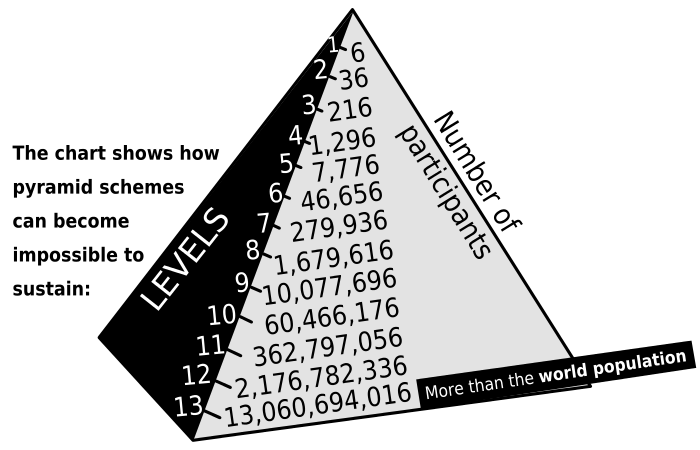
All financial scams are bad, but some are worse than others. Because of the way they spread, pyramid scams such as OneCoin are uniquely insidious. It was sold using a technique called multilevel marketing (MLM). This is when people make a commission by selling stuff to their friends and family, who in turn sell to their friends and family, and on and on, cascading into a huge pyramid-shaped structure. Growth is exponential — if everyone recruits two people, it would take only 26 rounds of pyramid selling to reach everyone in the UK.

MLM is legal provided you have a real product to sell, and Ignatova’s genius was to realise it was the perfect vehicle to sell her fake coin. She recruited some of the world’s top MLM sellers, who made 10% commission on any direct sales — plus extra bonuses depending on how big the pyramid became. Many become extremely rich as the coin spread like wildfire. Whereas Madoff is thought to have conned a few thousand rich investors, most of the money laundered by Scott for Ignatova came from the hundreds of thousands of ordinary people languishing near the base of the OneCoin pyramid.

“We were hyper, we were buzzing,” Jen McAdam told, as part of investigation into the scam, recalling the moment her friend first told her about OneCoin in early 2016. “When this came along, I thought my prayers had been answered.” After watching an online webinar, McAdam invested about £8,000 — most of which was an inheritance from her late father. “You’re told you’re so lucky that you’re seeing this webinar, you’re in such early stages — it’s going to go like bitcoin, it’s going to go higher.” When she told her friends, they all wanted in too. Within three months, McAdam’s Glasgow-based network had collectively poured in £250,000. She made about £3,000 commission on that — which she immediately used to buy more OneCoin.

Although the full scale of the fraud is being revealed, it was estimated that UK investors such as McAdam parted with about £100m between 2014 and 2017. There are pockets of victims all over the country, often from communities that are relatively tight-knit. British Muslims were hit hard, having been told that OneCoin was compliant with Islamic law. The deaf community in the Midlands invested. Ultra-Orthodox Jewish groups in London — who have had to cut back their community bursaries as a result — were targeted with the same techniques that promoters used everywhere from Hong Kong to Palestine: don’t miss out on this once-in-a-lifetime opportunity. People are generally either too scared or too embarrassed to admit they have been conned — and who is going to report their uncle or sister or best friend to the police for having brought them into the scheme?
paserbyp: (Default)
The world’s largest cryptocurrency by market cap broke above the $5,000 mark for the first time since November and has so far sustained its rally, prompting some analysts to declare an end to the so-called “crypto winter.”
The renewed run has emboldened some analysts to make new calls, including one from a technical trader who correctly predicted bitcoin’s collapse in 2018, founder of Factor Research and Trading Peter Brandt. After bitcoin’s (BTC-USD) latest rally he’s now calling for a run up to $50,000 within the next two years.

“I believe that charts reflect underlying supply and demand fundamentals and that’s how we have to look at it. What’s happened from December of 2017 to 2018 is really an analog to what happened in the 2013 to 2015 bear market, where we saw sequential 10 up-and-down moves in the bear market and we’ve almost identically formed that same sort of pattern.”

Brandt, a 71-year-old trading veteran, pointed back to bitcoin’s parabolic advance following a 2015 low as a reason to suspect the rally.

“I think the analogs are holding remarkably well and based on those analog studies, I think cryptos now will go back into a parabolic bull market,” he said. “The only question I have is do we rally here some and then sometime in late summer check the late 2018 lows or not? There is a chance that it does, there’s a chance that it doesn’t.”

Looking at bitcoin’s relative risk-reward in the shorter term, Fundstrat Global Advisors issued a new note for clients this week highlighting underlying fundamental improvements, aside from the positive technical signals Brandt pointed out.

“We see fewer reasons to question the recent recovery [in] Bitcoin prices—the best quarter since 2017,” Fundstrat analysts wrote. “While the key technical price hurdle is BTC closing above its 200D (currently ~$4,600 and falling by $15 per day), we see 2019 as positive risk/reward.”

Pyramid

Mar. 11th, 2019 07:58 am
paserbyp: (Default)
Authorities have arrested one leader, last week on Wednesday, of a cryptocurrency project called OneCoin, which prosecutors allege was in fact a pyramid scheme rather than a functional currency. Konstantin Ignatov was arrested on a wire fraud conspiracy charge, while his older sister, Ruja Ignatova, has been indicted for money laundering, and wire and securities fraud, in a document unsealed yesterday. Ignatova is currently at large (More details: https://www.justice.gov/usao-sdny/pr/manhattan-us-attorney-announces-charges-against-leaders-onecoin-multibillion-dollar#_ftn2).

OneCoin, a Bulgaria-based company, was founded in 2014 and still has operations running today, according to the indictment. The company gave users a commission if they could convince others to buy OneCoin cryptocurrency, taking the familiar shape of a multi-level marketing scheme. It claimed to have over 3 million members worldwide, despite having no functional blockchain or public ledger.

Manhattan attorney Geoffrey Berman says in a government press release that the OneCoin leaders created a multibillion-dollar company “based completely on lies and deceit.” In a brief period between 2014 and 2016, OneCoin made €3.353 billion (roughly $3.7 billion) in revenue.

Prosecutors allege that the leaders lied to investors to inflate the value of a OneCoin from half a euro ($0.56) to almost 30 euros ($33.65) as of January this year. In reality, the leaders of the project emailed each other saying that they planned to “take the money and run and blame someone else for this.”

“These defendants executed an old-school pyramid scheme on a new-school platform,” New York County District Attorney Cyrus Vance said in a statement.

US authorities found in their investigation that OneCoin claimed to have a digital ledger for recording cryptocurrency transactions, but there wasn’t a public one that could be verified. In 2015, Ignatova started to give members of her project fake OneCoin tokens to sell, aptly calling them “fake coins.”

When members of OneCoin recently asked Ignatov when they would be able to cash out on their tokens, he allegedly responded, “if you are here to cash out, leave this room now, because you don’t understand what this project is about.”

OneCoin is known to be potentially fraudulent in various countries, including in the UK, Germany, Finland, India, China, and Bulgaria. Many authorities have warned about its behaviors and even attempted to halt the company’s operations.

Mark Scott, another person who assisted in the OneCoin project, was indicted last summer and faces a maximum of 20 years in prison. Ignatov also faces 20 years in prison, while Ignatova faces five separate charges, which could add to up a maximum of 85 years in prison if she’s found guilty on all counts.
paserbyp: (Default)
World Bank data shows that over $148 billion was sent abroad from the U.S. alone in 2017. As people leave nations gripped by hyperinflation, or simply move to look for better opportunities abroad, sending cash back home becomes a necessity. As the people in Venezuela are discovering, this can be cheaper, faster and simpler with bitcoin and other cryptocurrencies.

Bitcoin and cryptocurrency in general can get money from sender to receiver extremely quickly and at low cost. If you’re new to decentralized peer-to-peer currency, it’s worth familiarizing yourself with how it works. From there, one can choose which cryptocurrency you intend to use as a conduit for the fiat cash. Bitcoin core (BTC) and bitcoin cash (BCH) are popular, though ripple (XRP) and ethereum (ETH) are other options you may wish to consider.

After selecting your desired cryptocurrency, the next step is to choose a wallet which can store it. Cryptocurrency wallets are essentially software programs that store your public and private keys and interface with various blockchains, allowing you to monitor your balance, send and receive money, and conduct other operations. There are different wallets to choose from: a desktop wallet, which would be downloaded and installed on your computer; an online wallet which runs from the cloud; or a mobile wallet, by far the most popular option as they can be used anywhere while on the go. Other options include hardware wallets which store a user’s private keys on a device like a USB, and paper wallets, which refer to a physical copy or printout of your public and private keys. Both are easy to use and provide a very high level of security (More info: https://www.bitcoin.com/guides/how-to-choose-the-right-bitcoin-wallet).

Now here are four ways to send money abroad using crypto:

1. By far the simplest method for beginners, buying BTC on Localbitcoins and then using it to send cash abroad is extremely popular in developing nations in particular. You simply need to open an account, search for people selling BTC in your country and go ahead and make a bank transfer to the seller. The platform is very secure and uses an escrow mechanism to hold funds, which means the coins can’t be released until both parties agree. Once the buyer has the BTC they wish to send abroad, they can send it to their contact’s crypto wallet, where they can then sell it, or perform the same process on Localbitcoins.com but in reverse. So, if a person wanting to send money from the U.S. to Venezuela wishes to use this method, they would find a buyer in Venezuela after having bought BTC in the U.S., then sell the BTC and receive fiat cash into a Venezuelan bank account. Look for a good fiat to BTC rate while using this method, as you will find many buyers and sellers on Localbitcoins.com with different rates.

2. Another increasingly popular platform for sending money abroad using cryptocurrency is Airtm. A digital wallet connected to banks and blockchains, Airtm makes sending money abroad via cryptocurrency very simple. As well as BTC and BCH, the platform supports a number of other currencies including ETH, XRP and monero (XMR). Opening an account is easy and Airtm provides a mid-market cryptocurrency exchange rate. There is a crypto dashboard on the website where you can see your total balance in USD equivalent inclusive of all your cryptocurrency balances. From there, you can buy and sell crypto and send it to other Airtm addresses. Recipients can then convert straight to fiat and withdraw.

3. Bitcoin ATMs (BATMs) are fast popping up everywhere, with over 4,000 scattered around the globe. They quickly allow users to get their hands on crypto or fiat cash. And as a way for sending money abroad, they are a gem. You need only find a BATM, buy BTC or other crypto, send to the recipient in another country and then the recipient can sell the crypto for cash at a BATM. The recipient doesn’t even need to know about cryptocurrency – they can simply make and send a photo of the QR code and the sender can use this bitcoin address directly, which can then be taken out of a BATM as cash. BATMs tend to charge a higher commission than other services mentioned here, it should be noted, so their convenience comes at a price.

4. A newer method of sending cash abroad is via Bloom Solutions. Founded by Luis Buenaventura, Bloom aims to reinvent the remittances industry using BTC. By focusing solely on cryptocurrency as a mechanism for cross-border money transfer, Bloom allows users to sign up, and when your credentials have been approved, a rate for using the service is given. You can then deposit funds into your Bloom account and Bloom takes care of it being sent abroad by sending it to a bank account or cash pick-up point. An email or SMS will confirm the completion of the transaction. Based in the Philippines, the service has been praised for its ability to help the unbanked receive remittances.

Ohio

Nov. 28th, 2018 04:38 pm
paserbyp: (Default)
Ohio this week began accepting bitcoin as a form of tax payment from businesses, making it the first U.S. state to do so.

The Ohio Treasurer's office said it is working to help make the state a national leader in blockchain, the underlying platform for bitcoin. Blockchain can be used for many different types of business transactions – from supply chain tracking to the creation of a mesh network for IoT devices.

The state treasurer's office uses the Atlanta-based bitcoin payment service provider, BitPay, to process the bitcoin payments.

More details: https://bitpay.com

Payments move over BitPay's blockchain electronic ledger, which offers real-time tracking; the payments are processed on one to three days. A "minimal fee" is charged to confirm the transactions and anyone can view all transactions on the blockchain network.

Bitcoin is currently the only cryptocurrency that can be used for payment at OhioCrypto.com, but the Treasurer's office said it plans to add other cryptocurrencies in the future.

Ohio businesses can also use ACH credit and debit, checks or money orders to pay taxes. The cryptocurrency payment option, via OhioCrypto.com, is the newest option for businesses and includes 23 different taxes.

In order to use the bitcoin payment service, Ohio businesses register online, enter their tax payment information and use a cryptocurrency wallet to pay the invoice with bitcoin. The payments are then processed by BitPay, which immediately converts the bitcoins to U.S. dollars before depositing the payment into a state account.

The value of both bitcoin and Ether, Ethereum's cryptocurrency, have tanked over the past year. The price of bitcoin has plummeted from nearly $20,000 to about $3,660, while Ether has dropped from more than $1,400 to $106.

The Ohio Treasurer's Office said the state and taxpayers are protected against market volatility as BitPay sets the exchange rate for a 15-minute allotted time window for each transaction once a business taxpayer begins to make their payment at OhioCrypto.com. BitPay then assumes the risk of any market fluctuations during the allotted time window.

Lawmakers in Arizona, Georgia, and Illinois have filed legislative proposals to use bitcoin as a form of payment to their state governments, but those efforts either died without resolution or were vetoed. In 2016, New Hampshire lawmakers voted down a bill that would have enabled tax payments for residents. In 2015, the Utah Senate passed a similar billl; it ultimately died in the House.

Utah's bill included a mention of Overstock.com because the online retailer both accepts bitcoin for payment and has invested heavily in start-ups developing the underlying platform, blockchain.

Because Ohio's state treasurer is an elected official, he was able to roll out the bitcoin payment program without legislative approval.

"Ohio has become the first state in the United States, and one of the first governments in the world, to accept cryptocurrency," the Treasuret's Office said on an FAQ page. "From mom-and-pop coffee shops to Fortune 100 companies, businesses now have the ability to pay their taxes with OhioCrypto.com."
paserbyp: (Default)

New York University professor and global economist Nouriel Roubini testified before the U.S. Senate Committee on Banking last week, saying cryptocurrencies such as bitcoin are the mother of all scams and bubbles. He followed that assertion up by calling blockchain, the technology unpinning bitcoin, "the most over-hyped — and least useful — technology in human history."

Yesterday, Roubini doubled down on his claims in a column published on CNBC.com in which he said blockchain has promised to cure the world's ills through decentralization but is "just a ruse to separate retail investors from their hard-earned real money."

Blockchain, which can be used to create a decentralized, permissioned electronic ledger for all kinds of business transactions, "has not even improved upon the standard electronic spreadsheet, which was invented in 1979," Roubini wrote in the op-ed column.

"There is no institution under the sun – bank, corporation, non-governmental organization, or government agency – that would put its balance sheet or register of transactions, trades, and interactions with clients and suppliers on public decentralized peer-to-peer permissionless ledgers," Roubini wrote. "There is no good reason why such proprietary and highly valuable information should be recorded publicly."

Roubini is known for having been one of the few economists who predicted the 2008 financial crisis. Yet, after witnessing bitcoin's fall in value over the past year, Roubini said it and other cryptocurrencies represent the mother of all market bubbles, enticing investors, "especially folks with zero financial literacy – individuals who could not tell the difference between stocks and bonds" – into a frenzy of bitcoin and crypto buying.

Roubini's testimony before the Senate Banking Committee was "certainly entertaining and will get lot of media attention," said Vipul Goyal, an associate professor in the Computer Science Department at Carnegie Mellon University (CMU). "However, it's unclear to me if he is really a technology expert and understands the world of crypto," he added.

Goyal pointed to leading tech vendors such as Amazon, IBM, Microsoft and Oracle who are investing heavily in blockchain and have rolled out blockchain-as-a-service offerings (BaaS) that let businesses use the cloud to create permissioned blockchains for business partners to use.

Prior to becoming a professor at CMU, Goyal worked as a Microsoft researcher for seven years. He noted that while he was employed there, Microsoft's CEO, Satya Nadella, spoke multiple times about his vision for blockchain.

"Surely, these are not naive gullible people which Roubini talked about," Goyal said.

Created in 2009, a single bitcoin's value as a universal digital currency skyrocketed in 2017 and early 2018, reaching $19,666 at its apex last year. Over the past nine months, however, bitcoin's value has tumbled more than 65% to about $6,500 today. Roubini called the collapse the "crypto-apocalypse."

At the same time bitcoin's value was plummeting, the technology underpinning it was growing in popularity as a business transaction tool, enabling a "permissioned" or private electronic ledger that is both immutable and transparent to anyone authorized to view it in a group.

Blockchain has been piloted and rolled out for cross-border financial transactions, as a platform for supply chain management and as the basis for a new "trust economy." Even healthcare facilities are investigating the technology as a way to securely exchange patient healthcare information.

In some ways, blockchain is a victim of its own success, Goyal said, noting that blockchain was taken "public" too soon.

"Wall Street and financial investors started tracking it on a daily basis and that became the measure of success rather than how the underlying technology was developing," Goyal said.

Any disruptive technology takes several years to play out, become mature and find its place in the world, he said. The internet, Goyal noted, needed a decade to gain traction, and AI took even more time. Even cloud computing took several years to catch on, he said.

"I think one should be patient and give [blockchain] time to mature rather than pass a sweeping judgement without any technical understanding just based on the price of cryptocurrencies," Goyal said.

Martha Bennett, a principal analyst at Forrester Research, said that while blockchain is not unique in its ability to securely exchange data among disparate parties, other technologies lack key blockchain attributes.

For example, blockchain-based architectures provide the basis for exchanging data and automating processes in a shared infrastructure, without any single party being in charge, Bennett noted.

"This, combined with the innovation opportunities inherent in the tokenization of digital and physical assets, means that we can build new business and trust models," Bennett said via email. "However, we need to design these first; evidence to date suggests that this is going to be the hardest part."

Roubini was adamant, however, arguing that the real revolution in financial services is FinTech – and it has nothing to do with Blockchain or crypto.

"It is a revolution built on artificial intelligence, big data, and the Internet of Things," he said.

Thousands of businesses such as PayPal, Venmo and Square use FinTech to disrupt every aspect of financial intermediation involving hundreds of millions of daily users in the US. Around the globe, billions more use similar low-cost, efficient digital payment systems such as Alypay and WeChat Pay in China; UPI-based systems in India; and M-Pesa in Kenya and Africa, according to Roubini.

"And financial institutions are making precise lending decisions in seconds rather than weeks, thanks to a wealth of online data on individuals and firms," Roubini said. "With time, such data-driven improvements in credit allocation could even eliminate cyclical credit driven booms and busts."

James Wester, IDC's research director Worldwide Blockchain Strategies, said he read all 37 pages of Roubini's Senate testimony and while some of his criticisms are "slightly overstated," they're not off-base – especially the ones concerning bitcoin, blockchain and financial services.

Blockchain and other cryptocurrencies are currently less efficient than existing solutions for clearing and settling a high volume of transactions, Wester noted.

For example, Roubini accurately pointed out that because its proof of work (PoW) consensus mechanism requires nodes (servers) to complete a complicated mathematical problem as a way of authenticating new data entries, bitcoin only allows for five to seven transactions a second.

"It is secure – so far – but at the cost of no scalability," Roubini told legislators. "And since its mining is now massively centralized – as an oligopoly of miners now control its mining – its security is at risk."

Industry groups, including the Ethereum Foundation, have taken on the challenge of increasing the scalability and performance of blockchains.

"But, he [Roubini] insists on using a very narrow definition of 'blockchain' that discounts implementations and use cases that are already seeing some traction and success," Wester said via email. "For instance, he says private permissioned blockchains are 'not truly a 'blockchain.'"

Wester took the biggest exception to Roubini's implication that everyone involved in blockchain is a charlatan.

"There are certainly people who are selling blockchain as a panacea for just about everything that plagues humanity, but even within the community of technology providers, programmers and more who are involved in blockchain projects – those people are not taken seriously," Wester said.

"There are also plenty of thoughtful, smart people involved in blockchain across multiple industries who are looking to apply the technology – even as Professor Roubini defines it – to solve some interesting problems," he continued. "It might be more fruitful to engage them in good faith."

More details: https://www.banking.senate.gov/imo/media/doc/Roubini%20Testimony%2010-11-18.pdf

and

https://www.project-syndicate.org/commentary/blockchain-big-lie-by-nouriel-roubini-2018-10
paserbyp: (Default)
AN OLD saying holds that markets are ruled by either greed or fear. Greed once governed cryptocurrencies. The price of Bitcoin, the best-known, rose from about $900 in December 2016 to $19,000 a year later. Recently, fear has been in charge. Bitcoin’s price has fallen back to around $7,000; the prices of other cryptocurrencies, which followed it on the way up, have collapsed, too. No one knows where prices will go from here. Calling the bottom in a speculative mania is as foolish as calling the top. It is particularly hard with cryptocurrencies because, there is no sensible way to reach any particular valuation.

It was not supposed to be this way. Bitcoin, the first and still the most popular cryptocurrency, began life as a techno-anarchist project to create an online version of cash, a way for people to transact without the possibility of interference from malicious governments or banks. A decade on, it is barely used for its intended purpose. Users must wrestle with complicated software and give up all the consumer protections they are used to. Few vendors accept it. Security is poor. Other cryptocurrencies are used even less.

With few uses to anchor their value, and little in the way of regulation, cryptocurrencies have instead become a focus for speculation. Some people have made fortunes as cryptocurrency prices have zoomed and dived; many early punters have cashed out. Others have lost money. It seems unlikely that this latest boom-bust cycle will be the last.

Economists define a currency as something that can be at once a medium of exchange, a store of value and a unit of account. Lack of adoption and loads of volatility mean that cryptocurrencies satisfy none of those criteria. That does not mean they are going to go away (though scrutiny from regulators concerned about the fraud and sharp practice that is rife in the industry may dampen excitement in future). But as things stand there is little reason to think that cryptocurrencies will remain more than an overcomplicated, untrustworthy casino.

Can blockchains—the underlying technology that powers cryptocurrencies—do better? These are best thought of as an idiosyncratic form of database, in which records are copied among all the system’s users rather than maintained by a central authority, and where entries cannot be altered once written. Proponents believe these features can help solve all sorts of problems, from streamlining bank payments and guaranteeing the provenance of medicines to securing property rights and providing unforgeable identity documents for refugees.

Those are big claims. Many are made by cryptocurrency speculators, who hope that stoking excitement around blockchains will boost the value of their related cryptocurrency holdings. Yet firms that deploy blockchains often end up throwing out many of the features that make them distinctive. And shuttling data continuously between users makes them slower than conventional databases.

As these limitations become more widely known, the hype is starting to cool. A few organisations, such as SWIFT, a bank-payment network, and Stripe, an online-payments firm, have abandoned blockchain projects, concluding that the costs outweigh the benefits. Most other projects are still experimental, though that does not stop wild claims. Sierra Leone, for instance, was widely reported to have conducted a “blockchain-powered” election earlier this year. It had not.

Just because blockchains have been overhyped does not mean they are useless. Their ability to bind their users into an agreed way of working may prove helpful in arenas where there is no central authority, such as international trade. But they are no panacea against the usual dangers of large technology projects: cost, complexity and overcooked expectations. Cryptocurrencies have fallen far short of their ambitious goals. Blockchain advocates have yet to prove that the underlying technology can live up to the grand claims made for it.

Profile

paserbyp: (Default)
paserbyp

January 2026

S M T W T F S
     1 2 3
4 5678910
11121314151617
18192021222324
25262728293031

Most Popular Tags

Syndicate

RSS Atom

Style Credit

Page generated Jan. 5th, 2026 08:33 pm
Powered by Dreamwidth Studios